TV Mounting Guide
Short answer: no. A TV power cord inside a wall is against the National Electrical Code, it is a fire hazard, and it can void your home insurance if a fire ever traces back to it. The good news is there are legal ways to get the same clean look, with no cords showing, and this page explains every one of them.
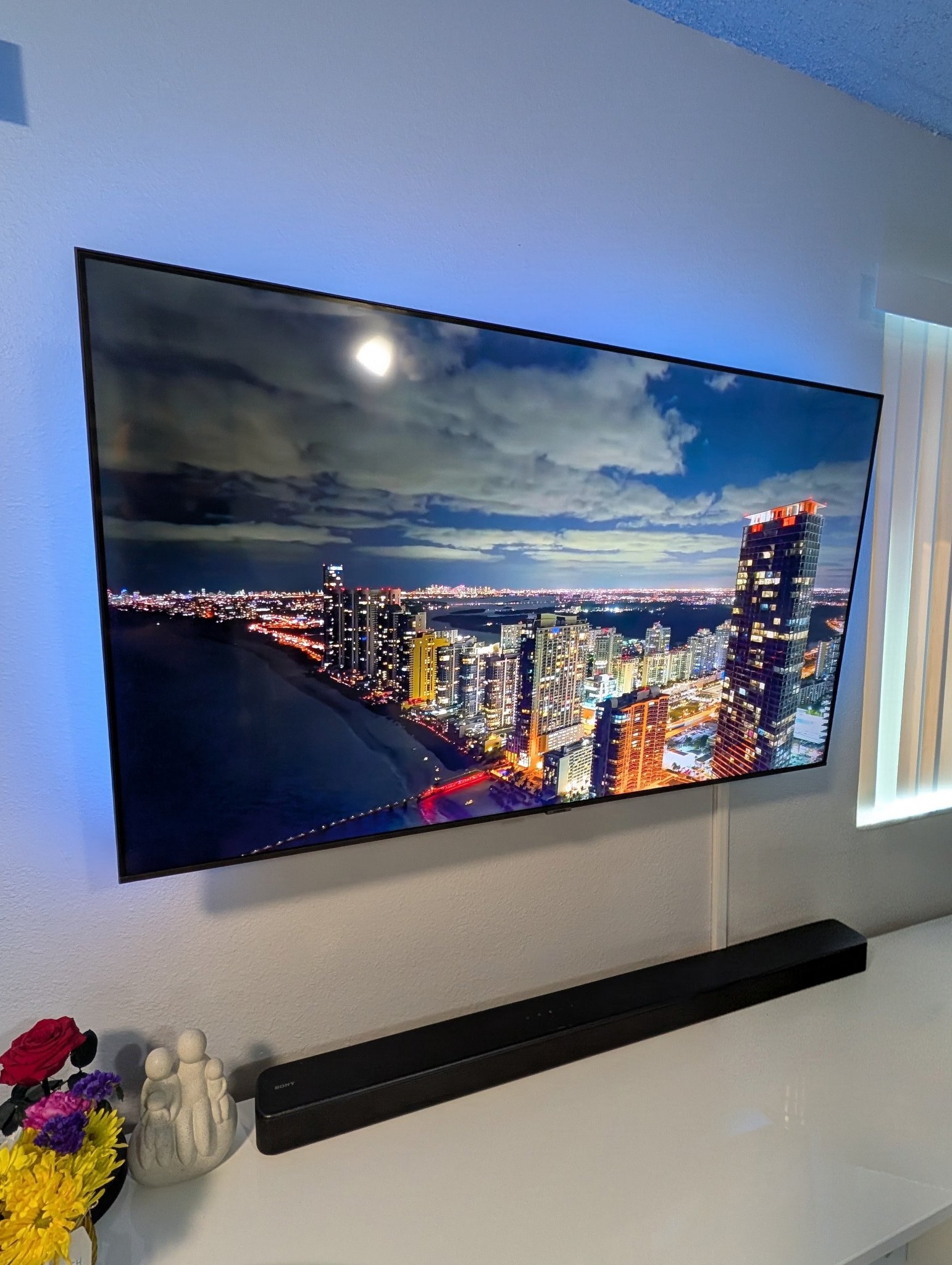
No. A power cord cannot go inside a wall. Not the TV's own cord, not an extension cord, not a power strip. It does not matter how clean it would look. The electrical code bans it, it is a fire hazard, and we will not do it, even when a customer asks us to.
The one-line version: signal cables like HDMI can go inside the wall. The power cord cannot. Everything below is why, and what to do instead.
A power cord is a flexible cord, built to be used out in the open where air moves around it and heat escapes. Inside a wall cavity, none of that is true. Heat builds up around the cord. The cord can get pinched by a screw or a staple, or wear against the edge of a hole, and all of it happens where nobody can see it. If that cord shorts or overheats, the fire starts inside your wall, and by the time you smell smoke it is already a wall fire.
That is the whole reason the rule exists. It is not about looks, and it is not a technicality.
Article 400 of the National Electrical Code (sections 400.8 and 400.12) covers flexible cords. It says a flexible cord cannot be used as a substitute for the permanent wiring of a building, and it cannot run through holes in walls, ceilings, or floors. A TV power cord is a flexible cord, so running one inside a wall breaks the code in just about every city and county in the country, including all of Miami-Dade.
Two practical problems follow. First, it can fail a home inspection, which turns into your problem when you sell the house. Second, if a fire ever traces back to a cord that was run against code, your home insurance company can deny the claim. The installer who did it is long gone by then. The risk stays with the homeowner.
Low-voltage signal cables are a different story. HDMI cables, optical audio cables, coax, and ethernet can go inside a wall, as long as they carry an in-wall rating (look for CL2 or CL3 on the cable). Those are exactly the cables our in-wall concealment service hides, $99 added to a TV mount. It is only the power cord that has to stay out of the wall.
There are three good ways to get rid of the dangling power cord without breaking the code:
A licensed electrician adds a proper outlet on the wall behind the TV, wired with in-wall rated cable and a real box. The TV plugs in right behind itself and no cord shows at all. This is the best-looking option. It is electrician work, usually $300 or more, and we are not electricians, so we do not do this part. We can recommend one, and we mount the TV once the outlet is in.
Kits made for this job (PowerBridge is the best-known name) move power from an existing outlet up to behind the TV through a cable that is rated for in-wall use, between two recessed plates. Because the in-wall part is a rated cable and the kit is UL or ETL listed, it is code compliant when it is installed the way the maker directs. If you go this route, check the box for a UL or ETL listing. A no-name kit with no listing is not the same thing.
The power cord runs down the wall inside a slim cover that paints to match your wall. No cutting, no code issues, and on most walls it all but disappears. We add a cable cover for $35 with a mount, and it is the option most of our customers pick.
When you book in-wall concealment with us, we hide the signal cables inside the wall, and the power cord gets handled one of the legal ways above: a cable cover, or an outlet behind the TV if you have one added. If you pick in-wall concealment in our booking page, you will see this same warning before you book, because we would rather explain it up front than argue about it in your living room. We never put a power cord inside a wall. Not as a favor, not for extra money, not ever.
A lot of homes do, from a do-it-yourself job or a past installer who cut the corner. It is worth fixing before it fails an inspection or turns into an insurance fight. We can take the TV down, pull the cord out of the wall, and set the whole thing back up one of the legal ways, usually in the same visit.
Yes. Article 400 of the National Electrical Code does not allow flexible cords, like a TV power cord or an extension cord, to run through a wall, ceiling, or floor, or to be used in place of permanent wiring. It is also a fire hazard, because a power cord is not rated to sit enclosed inside a wall.
Yes. HDMI cables and other low-voltage signal cables can go inside a wall when they carry an in-wall rating, CL2 or CL3. Hiding those cables is exactly what our in-wall concealment service does. It is only the power cord that has to stay out of the wall.
A power cord is built to be used out in the open, where heat escapes. Inside a wall cavity, heat builds up around it, and the cord can get pinched or worn where nobody can see the damage. If it shorts, the fire starts inside the wall.
It can. If a fire traces back to a cord that was run against code, the insurance company can deny the claim. The same setup can also fail a home inspection, which becomes a problem when you sell the house.
Three ways: a licensed electrician adds a real outlet behind the TV, a listed in-wall power kit moves the power through a rated cable, or the signal cables go inside the wall and the power cord runs in a paintable cable cover. The cover and the in-wall signal cables are part of our installs, and we can recommend an electrician for the outlet.
We mount the TV, hide the signal cables inside the wall, and handle the power cord the safe way. Flat rate up front, $1M insured, 1-year guarantee.
Book now Call or text 786-967-3984